
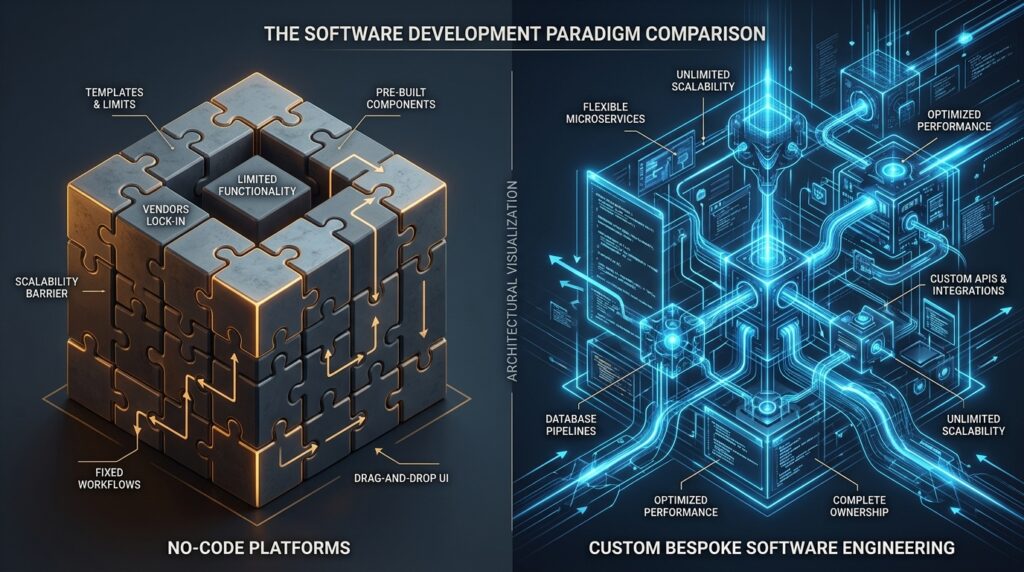
🛡️ Key Takeaways & Strategic Summary
- The MVP Phase: No-code platforms excel at fast hypothesis validation and low-cost prototyping during early market testing.
- The Scalability Wall: Exponential per-user pricing, sluggish response times, and limited database querying make no-code expensive at scale.
- Complete Data Ownership: Bespoke custom software gives you 100% intellectual property ownership, database sovereignty, and custom security controls.
- Long-Term ROI: A custom application eliminates recurring platform tax, delivering superior unit economics as transaction volume grows.
No-code tools like Webflow, Bubble, and Zapier have revolutionized rapid prototyping. However, as an enterprise grows past initial validation, the limitations of pre-built templates, proprietary database silos, and steep usage-based pricing become major bottlenecks to expansion. Knowing when to transition from no-code to bespoke custom software engineering is critical for long-term scalability and business valuation.
1. Comparison Matrix: No-Code Platforms vs. Bespoke Engineering
| Evaluation Dimension | No-Code Platforms | Bespoke Custom Software |
|---|---|---|
| Time to Initial MVP | Days to Weeks (Pre-built drag-and-drop visual UI) | Weeks to Months (Engineered architecture) |
| Scalability & High Concurrency | Severely restricted by proprietary vendor execution limits | Virtually limitless cloud scalability (Docker/K8s/AWS) |
| Data Sovereignty & IP Ownership | Locked in vendor cloud; no source code export; high vendor risk | 100% owned source code, custom encryption, SOC2 ready |
| Operational Cost at Scale (50k+ Users) | Exponentially high usage-based tier fees ($5k-$20k/month) | Predictable, low fixed infrastructure cost ($200-$800/month) |
| Custom Integrations & APIs | Limited to pre-built plugins and webhook connectors | Complete freedom to build custom protocols, WebSockets & APIs |
2. The Tipping Point: 4 Signs You Have Outgrown No-Code
- Complex Business Logic Workarounds: When your engineering team is stringing together fragile multi-step Webhook integrations that break on edge cases and cause data desynchronization.
- Slow Database Query Execution: When search, sorting, and reporting over thousands of customer records takes more than 3 seconds to render due to unindexed database abstraction layers.
- Vendor Lock-in and Escalating Tier Taxes: When your monthly SaaS subscription fees exceed the amortized cost of dedicated custom cloud infrastructure.
- Enterprise Compliance Roadblocks: When enterprise B2B prospects refuse to sign contracts because your application cannot provide isolated single-tenant databases, on-premise deployment, or custom SLA guarantees.
3. The Migration Roadmap: From No-Code to Custom Code
PixaQuant specializes in helping scaling businesses transition from prototype platforms to robust, production-grade custom software architectures without interrupting ongoing operations:
- Data Modeling & Schema Extraction: Export proprietary no-code datastores into normalized PostgreSQL or MySQL relational schemas.
- API Gateway & Core Logic Reconstruction: Rebuild backend business rules in high-performance frameworks (Node.js, Laravel, Python).
- Modern Reactive Frontend: Deliver lightning-fast, accessible UI experiences with React, Next.js, or Vue.
- Automated CI/CD Deployment: Establish automated testing and deployment pipelines for zero-downtime releases.
4. Frequently Asked Questions (FAQ)
Is custom software development significantly more expensive than no-code?
Initial development requires higher upfront investment, but custom software eliminates recurring vendor platform taxes, resulting in vastly superior ROI once user volume exceeds initial validation stages.
Who owns the intellectual property of a custom software project?
With bespoke software built by PixaQuant, your business retains 100% intellectual property ownership of the source code, database architectures, and design assets.
Can our existing no-code data be migrated without data loss?
Yes. Using automated ETL scripts and database migration tools, all existing user records, orders, and historical logs are migrated seamlessly.
5. Build Your Proprietary Platform with PixaQuant
Ready to build a scalable, proprietary platform that grows with your business? Explore PixaQuant’s Custom Software Development Services or book an engineering consultation today.
4. Long-Term Total Cost of Ownership (TCO) Analysis
When evaluating software platform investments over a 3-to-5 year horizon, the financial economics of custom engineering vs no-code platforms reveal significant divergence:
- No-Code Subscription Traps: As your application scales from 1,000 to 50,000 active monthly users, platform tier fees, database add-ons, and third-party automation connector costs often exceed $10,000+ every month.
- Custom Infrastructure Predictability: Containerized applications running on scalable cloud infrastructure (AWS, DigitalOcean, Hetzner) handle tens of thousands of concurrent users for a predictable fraction of the cost ($300 – $800/month).
- Enterprise Asset Value: A bespoke software platform represents valuable intellectual property that increases company enterprise valuation, whereas no-code projects are difficult to audit or sell to institutional investors.