
🛡️ Key Takeaways & Strategic Summary
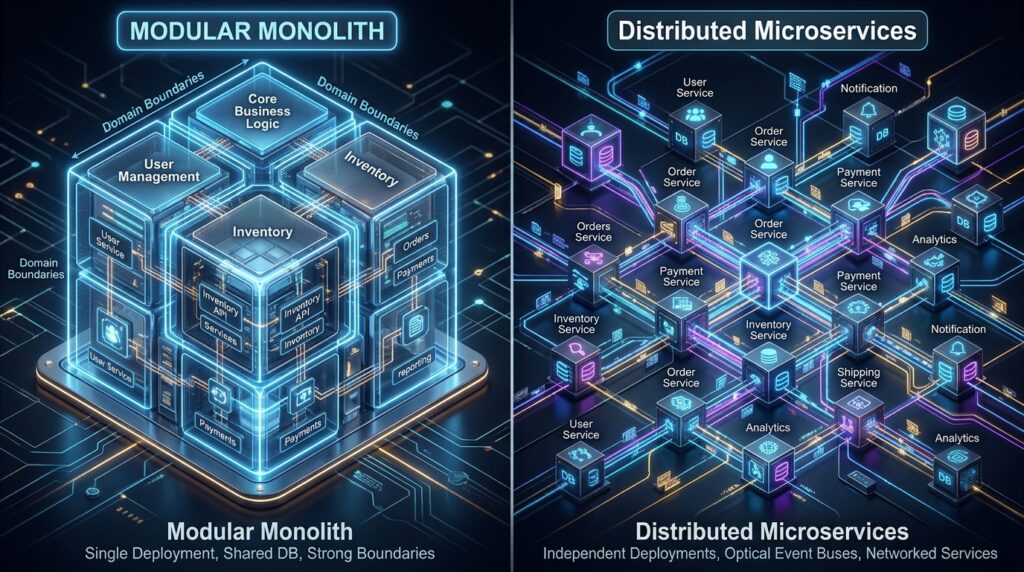
- The Microservices Tax: Microservices introduce distributed transactions, network serialization overhead, complex tracing, and high DevOps operational costs.
- The Modular Monolith Alternative: Organizing a single codebase into strictly bounded domain modules delivers microservice-level code hygiene with in-process speed.
- Clear Extraction Paths: When a specific domain module (e.g. video rendering or billing) requires independent hardware scaling, it can be cleanly extracted into a dedicated service.
- Pragmatic Architectural Decision Framework: Evaluate team size, organizational boundaries, and transaction complexity before splitting architectures.
Over the past decade, the software industry embraced microservices as the default architecture for modern web applications. However, at PixaQuant, we frequently rescue startups and scaleups who adopted microservices too early—only to find themselves trapped in a slow, brittle distributed monolith plagued by network latency, impossible local debugging, and runaway cloud bills.
1. The Hidden Costs of Premature Microservices
Splitting an application into 15 independent microservices before achieving clear domain stability introduces immense operational friction:
- Distributed Transactions & Data Inconsistency: Handling cross-service transactions requires complex Saga patterns and two-phase commits rather than simple atomic SQL transactions.
- Network Latency & Serialization Overhead: In-process function calls (taking nanoseconds) are replaced by HTTP/gRPC network calls (taking 15-50ms each), compounding latency across nested service chains.
- DevOps Operational Burden: Managing dozens of Docker containers, Kubernetes service meshes, CI/CD deployment pipelines, and distributed tracing systems (Jaeger/Zipkin) diverts engineering focus away from building product features.
2. What Is a Modular Monolith?
A Modular Monolith is a single deployed application whose internal codebase is strictly partitioned into independent, decoupled domain modules with explicit public interfaces:
src/
  modules/
    identity/        # Auth, Users, Roles (Private tables & logic)
      public-api.ts  # Only exported interface for other modules
    billing/         # Subscriptions, Stripe webhooks, Invoices
      public-api.ts
    orders/          # Catalog, Checkout, Inventory
      public-api.ts
Modules communicate exclusively through structured in-memory domain events or public service interfaces. Direct cross-module database joins are strictly forbidden by architectural linting rules.
3. Comprehensive Comparison Matrix
| Architectural Attribute | Modular Monolith | Microservices |
|---|---|---|
| Deployment Complexity | Low (Single Docker container / CI pipeline) | High (Kubernetes, service meshes, N pipelines) |
| Data Consistency | ACID atomic relational transactions | Eventual consistency / Saga patterns |
| Inter-Module Communication | In-memory method calls (< 1µs) | HTTP/gRPC network hops (10-50ms) |
| Optimal Team Size | 1 to 50 Engineers | 100+ Engineers across multiple squads |
4. The Evolutionary Path: Extracting Only When Necessary
Because a Modular Monolith enforces strict domain boundaries from day one, when a specific module outgrows the main application (for example, a high-CPU video transcoding worker or a dedicated reporting engine), our engineers can cleanly extract that single module into an independent microservice in days—without rewriting the core business application.
5. Frequently Asked Questions (FAQ)
Can a Modular Monolith scale to handle millions of requests?
Absolutely. Companies like Shopify, GitHub, and Stack Overflow handle billions of daily requests on monolithic architectures by scaling horizontal application instances behind load balancers and utilizing database read replicas.
How do you prevent developers from violating module boundaries?
We enforce architectural linting rules (such as dependency-cruiser in TypeScript or ArchUnit in Java/PHP) inside our CI/CD pipelines, automatically failing pull requests that attempt illegal cross-module imports.
6. Engineer Scalable Software with PixaQuant
Choosing the right architecture sets the foundation for your company’s technical velocity. Explore PixaQuant’s Software Architecture Consulting or book a technical review with our senior architects today.
4. Enforcing Domain Boundaries with Dependency Linting
The primary danger of a monolithic codebase is gradual degeneration into ‘spaghetti architecture’ where modules cross-reference each other’s private classes. At PixaQuant, we enforce boundary integrity at build time:
// .dependency-cruiser.js - Architectural Linting Rules
module.exports = {
  forbidden: [
    {
      name: 'no-cross-module-private-imports',
      comment: 'Modules must only import from the public-api of another module',
      severity: 'error',
      from: { path: '^src/modules/([^/]+)' },
      to: {
        path: '^src/modules/([^/]+)',
        pathNot: ['^src/modules/$1', '^src/modules/[^/]+/public-api\.ts$']
      }
    }
  ]
};
5. Database Management in a Modular Monolith: Separate Schemas
A common anti-pattern in monolithic databases is allowing any table to join with any other table. In our architecture, each module operates on its own dedicated PostgreSQL schema (e.g. identity.users, billing.subscriptions, orders.line_items):
- Schema-Level Grants: Application database users are granted strict access policies per domain service, preventing unintentional cross-module data coupling.
- Independent Domain Events: Modules communicate state mutations by emitting typed domain events (e.g.
OrderCompletedEvent) into an in-memory event dispatcher rather than invoking direct class methods. - Zero-Downtime Schema Evolutions: Database migrations are segregated by module directory, allowing team squads to test and deploy schema changes independently.