
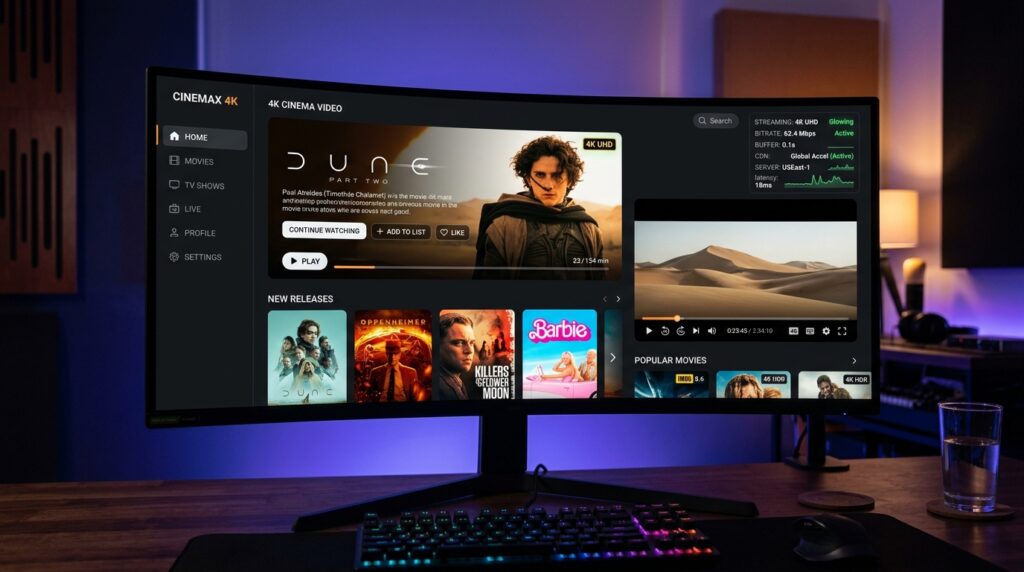
🛡️ Key Takeaways & Strategic Summary
- Decoupled Media Storage: Never store video master files directly on your web server; offload media to S3-compatible object storage paired with a global CDN.
- Adaptive Bitrate Streaming (HLS/DASH): Segment video streams to deliver seamless playback across mobile and desktop connections.
- Lightweight Theme Architecture: Eliminate monolithic page builders to ensure instant DOM rendering and dark-mode aesthetic fluidity.
- Sinematik Theme: PixaQuant’s specialized WordPress theme built specifically for cinema portals, media networks, and streaming catalogues.
Video streaming portals, cinema platforms, and high-traffic media networks face unique software engineering hurdles: massive bandwidth throughput, tens of thousands of concurrent connections, and the risk of severe Core Web Vitals degradation if video player scripts block main-thread rendering. When architected correctly, WordPress can comfortably serve millions of streaming sessions with sub-second page loads.
1. Decoupled Video Infrastructure Architecture
To achieve sub-second page loads on a streaming portal, the WordPress server must never act as a direct video file server. The web host should handle only catalog metadata, user authentication, and search routing—while video byte streams are offloaded entirely to edge CDN nodes using modern HLS (HTTP Live Streaming) protocols:
- Cloud Object Storage (AWS S3, Cloudflare R2): Video master files and transcode-segmented streams (.m3u8 playlists and .ts video chunks) are stored in scalable object storage buckets with zero egress fees where possible.
- Global Edge CDN Delivery: Video segments are cached geographically close to the end user, completely eliminating origin server bandwidth exhaustion during traffic spikes.
- Asynchronous Player Initialization: Heavy JavaScript player libraries (such as Video.js, Plyr, or HLS.js) are initialized lazily upon user interaction rather than blocking initial DOM painting.
2. Schema.org VideoObject Structured Data for SEO
Proper structured data ensures media titles appear with rich video preview cards, duration badges, and upload dates in Google Search, Google Discover, and video search tabs:
{
  "@context": "https://schema.org",
  "@type": "VideoObject",
  "name": "Dune Part Two - Exclusive 4K Trailer",
  "description": "Official 4K cinema trailer showcasing futuristic sci-fi visuals and sound design.",
  "thumbnailUrl": "https://pixaquant.com/wp-content/uploads/video-thumb.jpg",
  "uploadDate": "2026-09-08T10:00:00+00:00",
  "duration": "PT2M34S",
  "contentUrl": "https://cdn.example.com/videos/stream.m3u8",
  "embedUrl": "https://pixaquant.com/embed/dune-2",
  "publisher": {
    "@type": "Organization",
    "name": "PixaQuant Media",
    "logo": {
      "@type": "ImageObject",
      "url": "https://pixaquant.com/wp-content/uploads/2025/01/logo200.jpg"
    }
  }
}
3. The Engineering Behind the Sinematik Theme
Designed by PixaQuant, Sinematik delivers a Netflix-grade dark UI/UX with zero heavy framework bloat. Built with asynchronous video player initialization, responsive touch carousels, and optimized VideoObject schema markup, Sinematik turns WordPress into an ultra-fast media engine:
- Dark-Mode Native UX: High-contrast cinema aesthetic with zero CSS layout shifts (CLS < 0.05) and instant DOM rendering.
- Instant AJAX Live Search: Search through thousands of movies, episodes, and directors in under 30 milliseconds using localized JSON index caching.
- Responsive Multi-Source Player Embeds: Native support for self-hosted HLS streams, YouTube, Vimeo, BunnyCDN, and custom iframe CDNs with adaptive bitrate switching.
4. Server Caching & Database Optimization for Media Sites
High-traffic media sites require aggressive caching configurations:
- Full-Page Edge Caching: Cache guest page HTML at Cloudflare or Nginx FastCGI level, serving 95% of catalogue visits directly from RAM.
- Redis Object Caching: Cache complex taxonomy queries (genres, release years, actor relationships) in Redis to prevent heavy MySQL joins.
5. Frequently Asked Questions (FAQ)
Can WordPress handle 100,000+ daily streaming visitors?
Yes, provided video delivery is decoupled to a CDN/object storage layer and page HTML is cached via Nginx FastCGI or Redis.
Is Sinematik compatible with membership and paywall plugins?
Yes, Sinematik integrates seamlessly with WooCommerce Subscriptions, MemberPress, and custom REST API paywall gates.
6. Launch Your Streaming Platform with PixaQuant
Explore the Sinematik Theme or contact our media engineering specialists to launch your high-traffic streaming platform.
4. High-Performance Video Player Optimization Tactics
To prevent heavy video players from ruining your page performance metrics, implement these engineering best practices:
- Lazy Player Instantiation: Render lightweight visual thumbnail placeholders with pure CSS play buttons. Only load the full HLS.js or video player JavaScript bundle when the user explicitly clicks the play trigger.
- Preconnecting to Streaming CDNs: Add
<link rel="preconnect" href="https://cdn.example.com">tags to establish early TLS handshakes with video storage backends before playback starts. - Automatic Bitrate Switching: Deliver multi-rendition HLS playlists (1080p, 720p, 480p, 360p) allowing players to adapt seamlessly to mobile cellular fluctuations without stalling playback buffers.