
🛡️ Key Takeaways & Strategic Summary
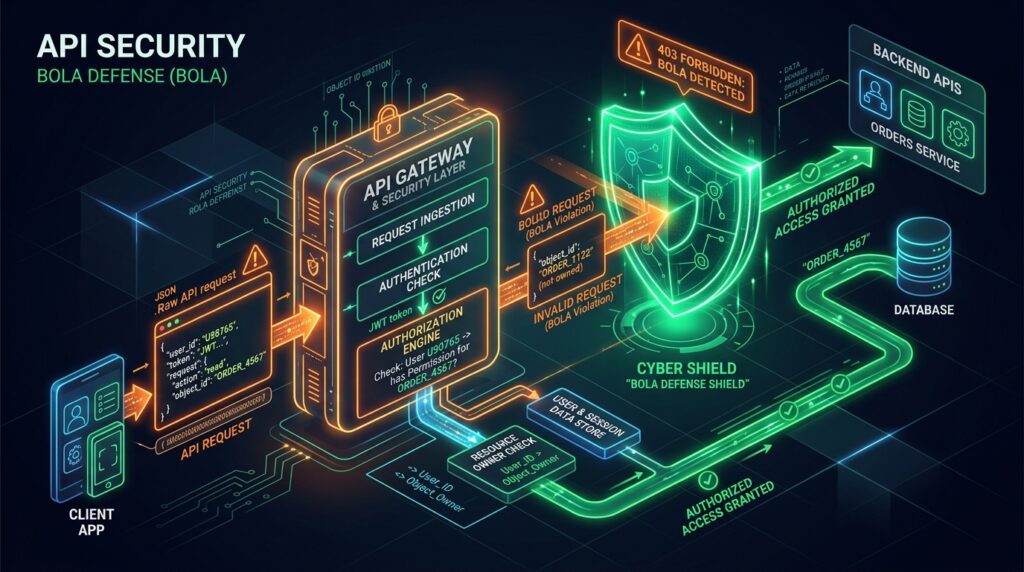
- Understanding BOLA: BOLA occurs when an API endpoint accepts an object identifier from user input without verifying whether the authenticated user has permission to access that specific record.
- Authentication vs Authorization: Having a valid JWT token only proves WHO the user is; object-level authorization proves WHAT they are permitted to see.
- UUIDs Are Not Security: Obfuscating IDs with UUIDv4 slows guessing but does not replace server-side ownership checks.
- Policy-Based Enforcement: Enforce authorization guards within middleware or domain service layers on every single request.
According to OWASP, Broken Object Level Authorization (BOLA / IDOR) remains the most widespread and dangerous vulnerability in modern API architectures. Attackers simply manipulate record IDs (e.g. changing /api/orders/1042 to /api/orders/1043) to exfiltrate private customer data without needing elevated administrative privileges.
1. The Anatomy of a BOLA Vulnerability
BOLA occurs when developers confuse Authentication with Authorization. An endpoint correctly checks that the client possesses a valid JWT token, but fails to check whether the user identified by that token actually owns or has permission to view the requested resource ID:
Insecure Endpoint Example (Vulnerable to BOLA):
# Insecure: Fetches record purely by ID without ownership validation
@app.get("/api/invoices/{invoice_id}")
def get_invoice(invoice_id: int, current_user: User = Depends(get_current_user)):
    # Flaw: Any logged-in user can access ANY invoice_id simply by guessing!
    invoice = db.query(Invoice).filter(Invoice.id == invoice_id).first()
    if not invoice:
        raise HTTPException(status_code=404)
    return invoice
Secure Endpoint Example (Ownership Enforced):
# Secure: Validates that the record belongs to the requesting user/tenant
@app.get("/api/invoices/{invoice_id}")
def get_invoice(invoice_id: int, current_user: User = Depends(get_current_user)):
    invoice = db.query(Invoice).filter(
        Invoice.id == invoice_id,
        Invoice.tenant_id == current_user.tenant_id  # Strict isolation check!
    ).first()
    if not invoice:
        raise HTTPException(status_code=404, detail="Resource not found")
    return invoice
2. Why UUIDv4 Does Not Replace Proper Authorization
A common misconception among developers is that switching integer IDs (1042) to random UUIDs (e7b1a2c4-3d...) solves BOLA. While UUIDs prevent sequential brute-force guessing, UUIDs frequently leak through HTTP referrers, API responses, analytics tracking, and shared team links. Without server-side authorization checks, anyone who obtains a UUID can still access the unauthorized record.
3. Implementing Attribute-Based Access Control (ABAC)
In complex SaaS applications where multiple team members have varying permission levels (e.g. Admin, Editor, Billing Manager, Viewer), simple ownership checks are insufficient. Implementing policy-based ABAC guards ensures fine-grained authorization:
class AuthorizationService:
    @staticmethod
    def verify_access(user: User, resource: Resource, action: str) -> bool:
        if user.is_super_admin:
            return True
        if resource.tenant_id != user.tenant_id:
            return False
        return action in user.role.permissions
4. Automated BOLA Testing in CI/CD
Integrate automated integration tests into your deployment pipeline that explicitly attempt cross-tenant resource access:
def test_user_cannot_access_other_tenant_resource():
    user_a_token = get_auth_token(user_id="user_a")
    user_b_order_id = "order_999_owned_by_b"

    response = client.get(f"/api/orders/{user_b_order_id}", headers={"Authorization": f"Bearer {user_a_token}"})
    assert response.status_code == 404 or response.status_code == 403
5. Frequently Asked Questions (FAQ)
Does GraphQL suffer from BOLA vulnerabilities?
Yes. In fact, nested GraphQL resolvers are even more susceptible to BOLA if authorization checks are only performed on top-level query nodes rather than individual field resolvers.
Should an unauthorized BOLA request return 401, 403, or 404?
Returning HTTP 404 (Not Found) is generally preferred over 403 because it prevents attackers from confirming whether a specific resource ID exists.
6. Secure Your APIs with PixaQuant
Ensure your backend services and mobile APIs are resilient against authorization breaches. Explore PixaQuant’s Application Security Services or schedule an API security audit today.
4. Designing Scalable Attribute-Based Authorization Guards (ABAC)
In multi-tenant SaaS platforms where organizations have complex organizational hierarchies (e.g., Regional Admins, Department Managers, Compliance Auditors, External Contractors), simple user-level checks must be upgraded to centralized authorization middleware:
# Centralized Object Authorization Guard
def authorize_resource_access(current_user: User, resource_owner_id: int, required_scope: str):
    if current_user.role == "super_admin":
        return True
    if current_user.tenant_id != current_user.tenant_id:
        raise HTTPException(status_code=404, detail="Resource not found")
    if current_user.id != resource_owner_id and required_scope not in current_user.permissions:
        raise HTTPException(status_code=404, detail="Resource not found")
    return True
- Deny-by-Default Architecture: Every new database entity endpoint must require explicit authorization decorators before returning data.
- Automated Fuzz Testing: Utilize automated security fuzzers in staging to manipulate JSON payload IDs and verify 100% rejection rates across all tenant boundaries.