
- 82% of real estate agents now use AI tools, up from an estimated 15% in 2023 (RPR survey, reported by HousingWire, February 2026).
- Generative AI can cut listing-creation time by up to 80% while raising inquiry rates (The AI Consulting Network, 2025).
- Agencies that pair multilingual content with
RealEstateListingstructured data reach more international buyers and show up inside AI search answers. - PropEngine, PixaQuant’s in-development Laravel platform, bundles description generation, translation, smart search, and schema into one system. Preview the documentation →
In 2026, real estate software stopped being a fancy database and started doing the actual writing, translating, and selling. According to a February 2026 Realtors Property Resource (RPR) survey, 82% of agents now use AI tools, a sharp rise from roughly 15% in 2023. Yet only about 17% say AI has had a major impact on their business outcomes so far. That gap between adoption and impact is exactly where the next generation of listing software competes. This guide breaks down what AI-driven real estate platforms actually do today, where they fall short, and what a modern system like PropEngine changes for agencies.
How Fast Is AI Adoption Moving in Real Estate?
The RPR survey, covered by HousingWire in 2026, found that 82% of agents have adopted AI tools, with writing and marketing as the leading use cases and time savings as the top reported benefit. Top performers pull ahead even faster: roughly 75% of high-producing agents use AI, and AI-assisted lead nurturing is linked to about a 40% lift in conversion on those teams.
Adoption is broad, but depth is uneven. Most agents still point AI at narrow tasks — a listing paragraph here, an email draft there — because their software stacks weren’t built around it. The platforms winning in 2026 treat AI as a first-class layer, not a bolt-on button.
Here’s the part most coverage misses: adoption percentages overstate real impact. When 82% of agents use AI but only 17% feel a major business effect, the bottleneck isn’t access to models — it’s workflow. Agents paste details into a chat tool, copy the output, switch to the MLS, paste again, then translate and reformat manually. The agencies pulling ahead are the ones whose software removes those handoffs entirely.

What Can AI Actually Do for Property Listings?
The clearest win is listing copy. A 2025 analysis from The AI Consulting Network estimates generative AI can reduce listing-creation time by up to 80% while increasing inquiry rates. Instead of a one-line “3+1, sea view, must see,” a model turns raw facts — rooms, area, price, features, neighborhood — into a structured description built around the keywords buyers actually search.
A capable platform does more than one paragraph. It produces a long SEO-friendly description, a short summary, highlight bullets, and a suggested meta title and description — all in one pass, all editable. The agent approves, the system publishes. No copy-paste chain across five tabs.
That same engine handles translation. A single listing becomes six localized versions without a freelance translator in the loop. For agencies in multilingual markets, that’s the difference between serving one city and serving a region.
Does Multilingual Content Win More International Buyers?
It does, and the math is simple. A listing locked to one language only competes for buyers who read it. Add five languages and the same property enters five search markets at once. International and investment buyers — a growing share of transactions in many regions — routinely research in their native language before they ever contact an agent.
The hard part isn’t translating words; it’s keeping data consistent. A serious platform separates the listing record from its translations, so price, area, and reference number stay identical across every language while titles, descriptions, and SEO metadata localize cleanly. Direction-aware layouts (left-to-right and right-to-left) handle languages like Arabic without breaking the design.
When we designed PropEngine at PixaQuant, we treated multilingual as a data problem, not a translation feature bolted on at the end. Property text lives in translation tables tied to the core record, so a Turkish, English, Arabic, Russian, German, or French version of the same listing always shares one source of truth. That structure is what lets AI translation run in bulk without creating orphaned or inconsistent content.
How Does Structured Data Help Listings Get Found?
Structured data is how listings travel beyond your own website. RealEstateListing schema from schema.org gives search engines and AI assistants a machine-readable version of every property: price, currency, rooms, area, geo-coordinates, and address. Without it, your listing is just text on a page. With it, the same listing can surface in Google results, map packs, and AI-generated answers.
As AI search engines and overviews grow, structured data matters more, not less. Models extract facts from pages they can parse reliably. A listing wrapped in clean JSON-LD is far easier for an AI assistant to quote — price, neighborhood, room count — than one buried in styled HTML.
The market backdrop supports the investment. Precedence Research projects generative AI in real estate growing at an 11.33% compound annual rate from 2026 through 2035, while Netguru reports 78% of organizations now use AI in at least one function, up from 55% a year earlier. Listings built for machines today compound in value as that curve keeps rising.
What Does This Look Like in One Platform? Meet PropEngine
Most agencies stitch this together from four or five separate tools: a CRM, a copy generator, a translation service, an SEO plugin, and a custom-fields hack for schema. PropEngine is PixaQuant’s answer — a single Laravel 13 platform that ships these capabilities together, designed for one real estate firm with multiple agents and multilingual reach.
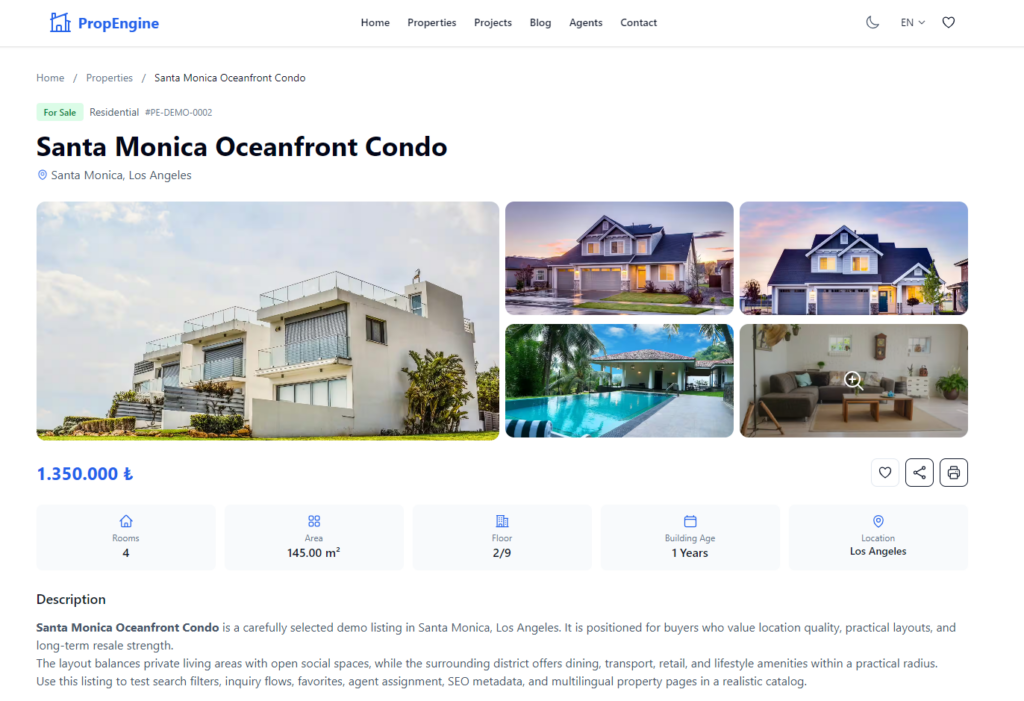
The system covers the full loop. AI generates and rewrites property descriptions. A translation pipeline produces localized versions across Turkish, English, Arabic, Russian, German, and French. An intelligent search filters by location, type, price, rooms, and features, with every filter reflected in shareable URLs. Listings publish with RealEstateListing, Article, and RealEstateAgent schema out of the box. A Filament v5 admin panel runs listings, agents, blog content, AI cost tracking, and SEO from one place.
PropEngine also exposes a public REST API (v1) and a first-party plugin architecture, so agencies and marketplace buyers can extend it — calculators, AI helpers, importers, custom property widgets — without editing core files. Reference plugins like a mortgage calculator and an AI assistant ship as working examples.
PropEngine is currently in development and not yet on the market. We’re sharing the architecture and feature set now so early readers — agencies evaluating their next platform, and developers considering extending it — can see the direction. You can read the full documentation and installation guide on our docs site, including the API reference, plugin development guide, and support policy.
Frequently Asked Questions
Is AI-generated listing content allowed by real estate platforms?
Yes, with disclosure and review. Most MLS and marketplace rules permit AI-assisted copy as long as claims stay accurate and the agent reviews the output before publishing. Treat AI as a drafting tool, not an autopilot, and verify every factual detail.
Does multilingual SEO actually drive more leads?
It widens your reachable audience. A listing translated into five languages enters five search markets from one source record. The lift depends on your buyer mix, but in international and investment-heavy markets the additional reach is measurable.
What is RealEstateListing schema and why does it matter?
It’s a structured-data format from schema.org that describes a property in machine-readable terms — price, rooms, area, location. It helps search engines and AI assistants parse and surface your listings accurately in results and AI-generated answers.
Conclusion: Software That Does the Work
The 2026 numbers tell a clear story: agents have adopted AI in droves, but the business impact is still concentrated among those whose software removes the handoffs. Writing, translating, structuring, and publishing listings from one system is where the real gains show up.
That’s the bet behind PropEngine — not an AI chatbot next to a real estate tool, but a real estate platform built with AI at its core. It’s in active development, and you can follow along through the PropEngine documentation, where the installation guide, API reference, plugin architecture, and support policy all live. If you’re evaluating your agency’s next platform or building on top of one, that’s the best place to start.
Demo URL: https://propy.pixaquant.com/