
🛡️ Key Takeaways & Strategic Summary
- Defense-in-Depth Architecture: Relying on a perimeter firewall alone is obsolete. True resilience requires independent verification across source code, API endpoints, database tiers, and host operating systems.
- Shift-Left & DevSecOps: Security validation must not be an afterthought. Integrating SAST, DAST, and dependency scanning into automated CI/CD pipelines stops vulnerabilities before deployment.
- OS-Level Server Hardening: Enforcing SSH key authentication, disabling root logins, fine-tuning firewalls (UFW/iptables), and mandating TLS 1.3 drastically shrinks attack surfaces.
- Zero-Trust Data Protection: Sensitive records must be isolated and encrypted both at rest (AES-256) and in transit, governed by strict Role-Based Access Controls (RBAC).
In 2026, web applications, SaaS platforms, and enterprise digital infrastructures operate in an increasingly hostile threat landscape. Autonomous AI-powered vulnerability scanners, targeted API breaches, distributed DDoS campaigns, and supply-chain compromises mean security is no longer an optional post-launch checklist item—it is the fundamental architectural pillar of sustainable growth.
1. Why Modern Digital Projects Are Targeted: The Evolving Threat Landscape
While legacy cyber attacks often exploited simple, unpatched software bugs or obvious brute-force entryways, modern threat actors exploit complex architectural blind spots across distributed cloud environments. Today’s primary risk vectors include:
- API Vulnerabilities & BOLA (Broken Object Level Authorization): As single-page applications (SPAs) and decoupled microservices dominate modern software engineering, authorization flaws at the API object level remain the single largest cause of unauthorized data exfiltration. Attackers do not need to break cryptography; they simply manipulate request IDs.
- Supply Chain & Third-Party Dependency Infiltration: Open-source packages, unverified npm/composer libraries, and neglected plugins can introduce critical remote code execution (RCE) backdoors into otherwise secure core codebases.
- Session Hijacking & Token Governance Failures: Long-lived JSON Web Tokens (JWT), insecure cookie flags without
HttpOnlyorSameSite=Strictattributes, and flawed refresh token lifecycles create easy entry points for persistent credential abuse. - Infrastructure Misconfigurations: Exposed default ports, unsegmented databases, and missing HTTP security headers turn minor server oversights into critical breaches.
2. Defense-in-Depth Architecture & DevSecOps Integration
A resilient digital security strategy adheres to the Defense-in-Depth paradigm: if one defensive layer is compromised, subsequent layers immediately contain the blast radius. Security must be shifted left—woven directly into the engineering workflow rather than bolted on at the finish line.
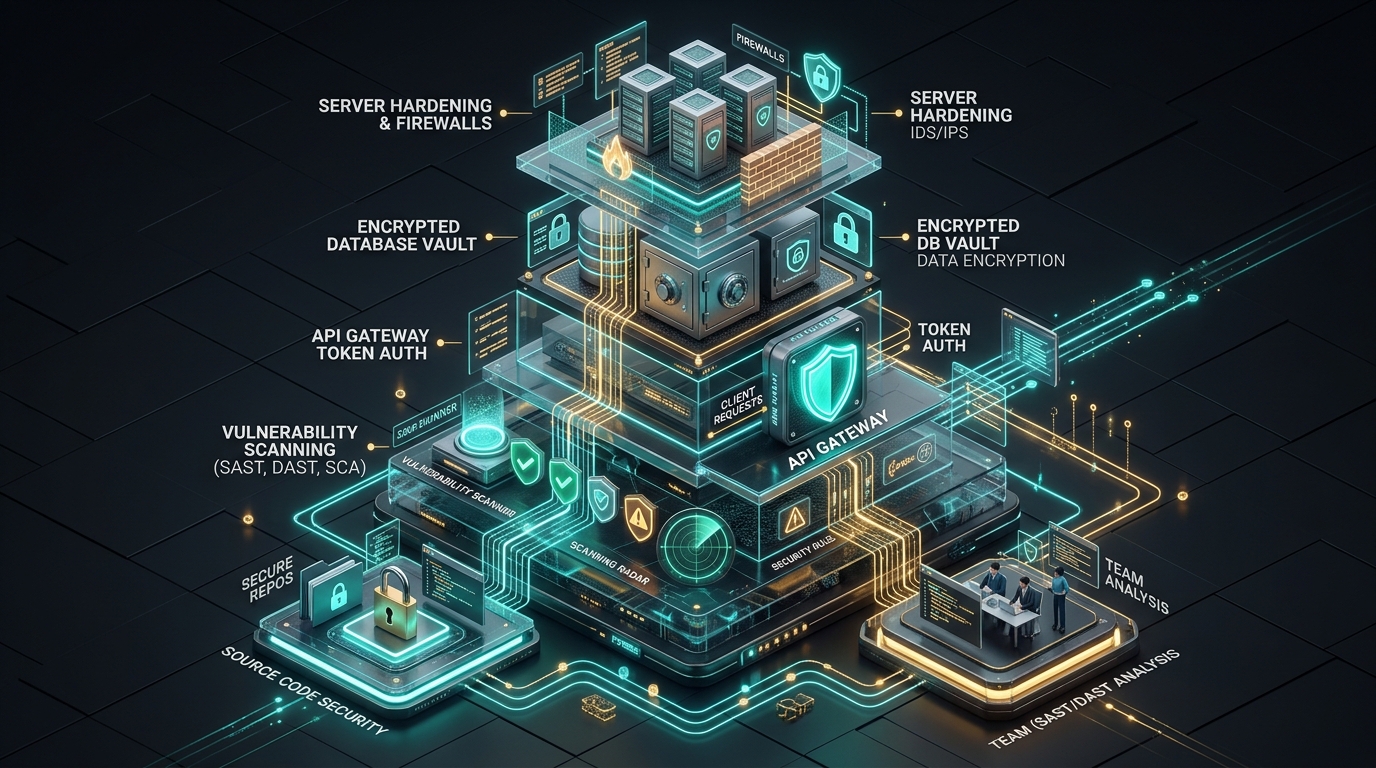
Core DevSecOps Pipeline Stages:
- SAST (Static Application Security Testing): Automated analysis running on every Git commit to catch SQL injections, cross-site scripting (XSS), and insecure cryptographic patterns before pull requests are approved.
- SCA (Software Composition Analysis): Real-time scanning of third-party package dependencies against live Common Vulnerabilities and Exposures (CVE) databases, immediately blocking builds with known high-severity exploits.
- DAST (Dynamic Application Security Testing): Automated behavioral stress-testing against staging environments to identify live endpoint vulnerabilities, CORS misconfigurations, and authentication loopholes.
3. Secure Coding & Application-Level Safeguards
Application security starts at the line-by-line code level. At PixaQuant, our engineering teams adhere to strict defensive coding standards:
- Strict Input Validation & Sanitization: All incoming payloads must be treated as untrusted. Enforce strict type checking, length constraints, and schema validations before data processing reaches the business logic layer.
- Parameterized Queries (Prepared Statements): Eliminate SQL Injection vectors completely by exclusively utilizing ORM abstractions and parameterized SQL bindings. String concatenation in database queries is strictly forbidden.
- XSS & CSRF Mitigation: Pair anti-CSRF tokens with comprehensive
Content-Security-Policy(CSP) headers to prevent unauthorized script execution and cross-site payload delivery.
4. API Security & Access Token Governance
APIs represent the central nervous system of modern SaaS and web platforms. Implementing enterprise-grade API governance requires:
- Granular Rate Limiting & Throttling: Enforce dynamic, IP- and user-based request thresholds (e.g., via Redis Token Bucket algorithms) to defend against credential stuffing, automated scraping, and DoS attacks.
- Short-Lived JWTs & Secure Token Rotation: Access tokens should expire in 15 minutes or less. Refresh tokens must be stored in secure, encrypted server-side databases, rotatable upon every single issuance.
- Principle of Least Privilege (PoLP): Restrict access scopes so services and users only interact with the exact data entities required for their immediate function.
5. Server Hardening & Network-Level Perimeter Security
Application security cannot succeed without a hardened host environment. Essential Linux server hardening measures include:
- SSH Isolation: Alter default management ports, explicitly disable root access (
PermitRootLogin no), and enforce Ed25519 cryptographic key-pair authentication. - Firewall Segmentation & Intrusion Prevention: Restrict external ingress strictly to ports 80/443 via UFW or iptables, paired with active
Fail2banmonitoring to drop malicious repeat offenders. - Modern Cryptography & Security Headers: Mandate TLS 1.3, configure HSTS (
Strict-Transport-Security), and enforceX-Content-Type-Options: nosniffalongsideX-Frame-Options: SAMEORIGIN.
6. Frequently Asked Questions (FAQ)
What is the most common security vulnerability in modern web applications?
Broken Object Level Authorization (BOLA) and insecure third-party dependencies currently account for the majority of severe enterprise data breaches.
How often should security audits and penetration testing be conducted?
Automated DevSecOps scans should run on every pull request, while comprehensive manual architecture audits and external penetration tests should be executed at least semi-annually.
7. Conclusion: Managing Security as a Continuous Lifecycle
Digital project security is not a one-time deployment milestone—it is a continuous operational discipline involving active logging, real-time observability, automated vulnerability patch cycles, and hardened data backups. Designing systems with security at their foundation guarantees both operational continuity and customer trust.
At PixaQuant, we engineer bespoke software platforms, scalable SaaS architectures, and hardened cloud infrastructures tailored for high-growth enterprises. Explore our Security Services or contact our engineering team to schedule a comprehensive technical security consultation.