
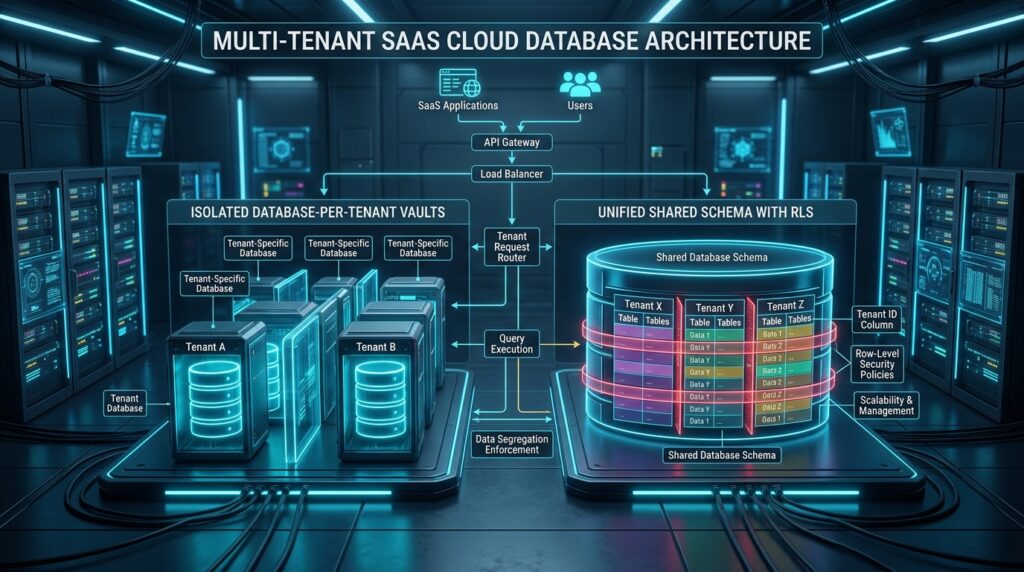
🛡️ Key Takeaways & Strategic Summary
- Database-Per-Tenant: Highest compliance and complete hardware/data isolation, ideal for enterprise SaaS with strict data residency regulations.
- Shared Schema with RLS: Maximum cost efficiency and resource utilization, using Postgres Row-Level Security (RLS) to enforce tenant isolation at the kernel level.
- Hybrid Partitioning: Modern high-scale architectures place free-tier tenants in shared pools while routing enterprise tiers to dedicated database instances.
- Operational Tradeoffs: Schema migrations, backup lifecycles, and connection pooling strategies differ drastically between isolation models.
Building an enterprise Software-as-a-Service (SaaS) application requires solving one fundamental architectural question early in the lifecycle: how will tenant data be segregated? Making the wrong choice can lead to runaway cloud hosting bills, catastrophic cross-tenant data leaks, or unmaintainable database schema migrations as user volume expands.
1. The Two Core Multi-Tenancy Paradigms
Multi-tenancy allows a single application instance to serve multiple distinct customer organizations (tenants). In relational cloud databases, two primary models dominate:
- Database-per-Tenant (Isolated Model): Every customer receives an independent physical database. Complete separation of compute, storage, and encryption keys.
- Shared Database with Shared Schema (Pooled Model): All tenants share the same database tables, with a global
tenant_idcolumn partitioning every query via Row-Level Security (RLS).
2. Comprehensive Architectural Comparison Matrix
| Architectural Dimension | Database-per-Tenant | Shared Schema (RLS) |
|---|---|---|
| Data Isolation & Security | Absolute (Separate physical files, user credentials, and encryption keys) | Logical (Software-enforced via database policies) |
| Infrastructure Cost & Efficiency | High (Idle compute and storage overhead per tenant database) | Low (Maximized hardware utilization, shared connection pools) |
| Schema Migration Complexity | High (Requires migrating N databases sequentially or in parallel workers) | Low (Single atomic migration applied to one shared database) |
| Backup & Restoration Granularity | Simple (Restore individual tenant DB without affecting other users) | Complex (Requires extracting tenant rows from full DB dumps) |
| Regulatory Compliance (HIPAA, SOC2, GDPR) | Streamlined approval for strict enterprise data residency | Requires rigorous cryptographic audits and proof of isolation |
3. Implementing Row-Level Security (RLS) in PostgreSQL
When implementing a shared schema, never rely solely on application-level WHERE tenant_id = ? clauses. Application developers will inevitably forget a filter in complex joins. Native PostgreSQL RLS policies enforce isolation directly at the database engine level:
-- Enable Row-Level Security on tenant data tables
ALTER TABLE accounts ENABLE ROW LEVEL SECURITY;
ALTER TABLE orders ENABLE ROW LEVEL SECURITY;

-- Define tenant isolation policy using session variables
CREATE POLICY tenant_isolation_policy ON orders
    FOR ALL
    USING (tenant_id = current_setting('app.current_tenant_id', true)::uuid);

-- Application middleware sets the session variable per request:
-- SET LOCAL app.current_tenant_id = 'e7b1a2c4-...';
4. Connection Pooling and Scaling Bottlenecks
In a database-per-tenant architecture, managing connection pools across thousands of tenants becomes a major bottleneck. Tools like PgBouncer or AWS RDS Proxy must be carefully configured to prevent connection starvation. In contrast, shared schemas require careful table indexing strategies:
- Every primary key and foreign key index must be prefixed with
tenant_id(composite indexing:(tenant_id, id)). - PostgreSQL table partitioning (declarative range/list partitioning by
tenant_id) should be adopted once table row counts exceed 50 million records.
5. The Modern Hybrid Pattern: Tier-Based Routing
High-growth SaaS platforms engineered by PixaQuant frequently implement a Hybrid Multi-Tenant Pattern:
- Free & Standard Tiers: Grouped into shared multi-tenant database pools with strict RLS enforcement, minimizing hosting overhead.
- Enterprise Tiers: Automatically provisioned dedicated, isolated databases via Terraform and Kubernetes operators, unlocking custom backup schedules and data residency guarantees.
6. Frequently Asked Questions (FAQ)
Which model is best for an early-stage SaaS startup?
Shared schema with PostgreSQL Row-Level Security (RLS) is overwhelmingly recommended for early-stage startups due to lower infrastructure costs and effortless schema migrations.
Can a SaaS platform migrate from Shared Schema to Database-per-Tenant later?
Yes. By utilizing clean repository abstractions and composite (tenant_id, id) indexing from day one, tenant data can be cleanly extracted and migrated to dedicated databases when enterprise contracts demand it.
7. Build Your Scalable SaaS with PixaQuant
Designing high-concurrency, secure SaaS architectures requires deep database expertise and proven design patterns. Discover our SaaS Engineering Solutions or schedule an architecture review with our senior engineering team.